
-
Sur nous
- Mission & Domaines d'action
- Histoire
- Acteurs
- Gouvernance
- Equipe du secrétariat
- Télécharger
- Emploi
- Financeurs
- Activités
- Rencontres Annuelles
- The 'New Extensionist'
- Nutrition et SCR
- Informatiques en SCR
- Global Good Practices
- Politiques pour les SCR
- Organisations de producteur et les SCR
- Egalié des genres dans SCR
- Améliorer les évaluations des SCR
- RAS Blogs
- Savoir
- Publications de GFRAS
- Global Good Practices
- Policy Compendium
- New Extensionist Learning Kit NELK
- Répertoire de fournisseurs SCR
- Répertoire de formation SCR
- Etude mondial de l'extension
- Tous les documents
- Communauté
- Réseaux regionals
- Forums nationaux
- Associés
- Groupes de travail
- Liste des experts
- GFRAS Update
- Message Board
- Community Area New
- Evénements
-
Sur nous
- Mission & Domaines d'action
- Histoire
- Acteurs
- Gouvernance
- Equipe du secrétariat
- Télécharger
- Emploi
- Financeurs
- Activités
- Rencontres Annuelles
- The 'New Extensionist'
- Nutrition et SCR
- Informatiques en SCR
- Global Good Practices
- Politiques pour les SCR
- Organisations de producteur et les SCR
- Egalié des genres dans SCR
- Améliorer les évaluations des SCR
- RAS Blogs
- Savoir
- Publications de GFRAS
- Global Good Practices
- Policy Compendium
- New Extensionist Learning Kit NELK
- Répertoire de fournisseurs SCR
- Répertoire de formation SCR
- Etude mondial de l'extension
- Tous les documents
- Communauté
All Categories
- Accueil /
- All downloads
Le « Nouveau Conseiller Agricole » : rôles, stratégies et capacités pour renforcer les services de vulgarisation et de conseil agricole, resuméAnnée:2012Téléchargements:11603Date:21 avril 2016Show detailsXLe « Nouveau Conseiller Agricole » : rôles, stratégies et capacités pour renforcer les services de vulgarisation et de conseil agricole, resumé
Résumé
 Bien que l’appui apporté aux communautés rurales en matière de renforcement de la vulgarisation et de conseil, ait fait l’objet de nombreux débats ces dernières années, l’on sait peu de choses sur la façon de renforcer les capacités nécessaires dans les services de vulgarisation et de conseil (SVC), et sur le rôle que ces services jouent dans le système d’innovation agricole (SIA). Le présent document vise à combler ce déficit de connaissances en articulant une nouvelle vision pour les SVC dans le SIA, que nous appelons le « Nouveau Conseiller Agricole », tout en reconnaissant que ceci ne concerne pas seulement les rôles et les capacités individuels mais également les rôles et les capacités aux niveaux organisationnel et des systèmes. Le présent document examine les moyens de développer les capacités nécessaires pour l’opérationnalisation de cette vision à ces différents niveaux.Le « Nouveau Conseiller Agricole » : rôles, stratégies et capacités pour renforcer les services de vulgarisation et de conseil
 Année:GFRASTéléchargements:14122Date:21 avril 2016Show detailsX
Le « Nouveau Conseiller Agricole » : rôles, stratégies et capacités pour renforcer les services de vulgarisation et de conseil
Bien que l’appui apporté aux communautés rurales en matière de renforcement de la vulgarisation et de conseil, ait fait l’objet de nombreux débats ces dernières années, l’on sait peu de choses sur la façon de renforcer les capacités nécessaires dans les services de vulgarisation et de conseil (SVC), et sur le rôle que ces services jouent dans le système d’innovation agricole (SIA). Le présent document vise à combler ce déficit de connaissances en articulant une nouvelle vision pour les SVC dans le SIA, que nous appelons le « Nouveau Conseiller Agricole », tout en reconnaissant que ceci ne concerne pas seulement les rôles et les capacités individuels mais également les rôles et les capacités aux niveaux organisationnel et des systèmes. Le présent document examine les moyens de développer les capacités nécessaires pour l’opérationnalisation de cette vision à ces différents niveaux.Nota Conceptual 7ma Reunión Anual del GFRASAnnée:2016Téléchargements:4271Date:20 avril 2016Show detailsXNota Conceptual 7ma Reunión Anual del GFRAS
La 7ma Reunión Anual del Foro Mundial para los Servicios de Asesoría Rural (GFRAS) tendrá lugar del 3 al 6 de octubre de 2016 en Camerún, con eventos paralelos los días 3 y 7 de octubre. El tema es el Papel de los Servicios de Asesoría Rural (SAR) para un Agroemprendimiento Inclusivo. Ésta será precedida por la Reunión Anual de la Red de Servicios de Asesoría Rural y Agrícola de África Occidental y Central (en francés: Réseau des Services de Conseil Agricole et Rural d’Afrique de l’Ouest et du Centre, RESCAR-AOC), un taller de GFRAS-GIZ sobre el Papel de los SAR en la Integración del Género en las Cadenas de Valor, además de otros importantes eventos de aprendizaje. El encuentro está organizado por GFRAS juntamente con RESCAR-AOC, el Foro Africano para los Servicios de Asesoría Agrícola (AFAAS), y el Ministerio de Agricultura y Desarrollo Rural de Camerún.
Note conceptuelle 7e réunion annuelle du GFRAS 2016Année:2016Téléchargements:5196Date:17 avril 2016Show detailsXNote conceptuelle 7e réunion annuelle du GFRAS 2016
La 7e réunion annuelle du Forum mondial pour le conseil rural (GFRAS) aura lieu du 3 au 6 Octobre 2016 au Cameroun. Les événements parallèles se tiendront les 3 et 7 octobre. La réunion sera placée sous le thème « le rôle des services de conseil rural (SCR) dans l’entreprenariat agricole inclusif ». Elle sera précédée de la réunion annuelle du Réseau des services de conseil agricole et rural d’Afrique de l’Ouest et du Centre, RESCAR-AOC) et d’un atelier GFRAS-GIZ portant sur le rôle des SCR dans l’intégration du genre dans les chaînes de valeur. Elle sera également marquée par d’autres activités pertinentes d’apprentissage. La réunion sera organisée par le GFRAS en partenariat avec le RESCAR-AOC, le Forum africain des services de conseil agricole (AFAAS) et le ministère de l’Agriculture et du Développement rural du Cameroun.
 Agricultural Innovation System: An Investment SourcebookAnnée:2012Téléchargements:5810Date:11 avril 2016Show detailsX
Agricultural Innovation System: An Investment Sourcebook
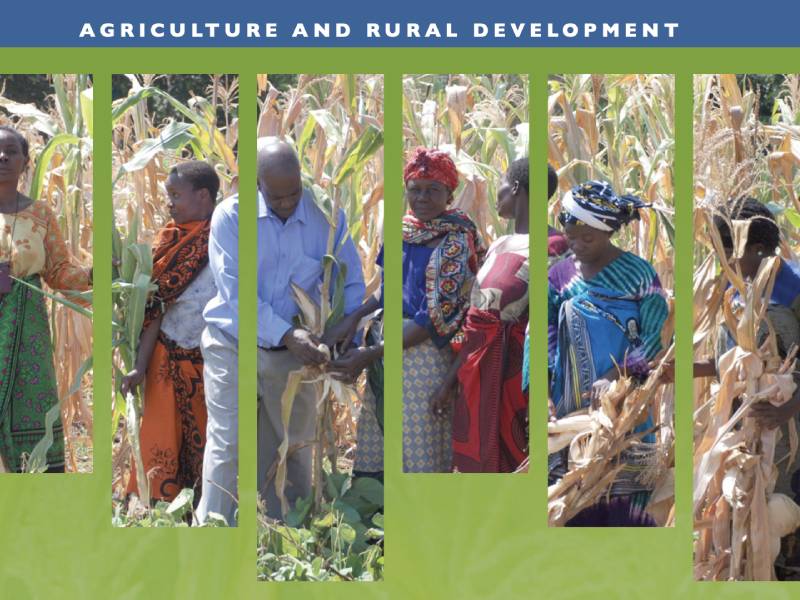
Research, education, and extension investments, while usually necessary, are often insuffi cient alone to bring knowledge, technologies, and services that enable farmers and entrepreneurs to innovate. Efforts to strengthen research systems and increase the availability of knowledge have not increased innovation or the use of knowledge in agriculture at the pace or the scale required by the intensifying and proliferating challenges confronting agriculture. Agricultural Innovation Systems: An Investment Sourcebook contributes to the identifi cation, design, and implementation of the investments, approaches, and complementary interventions most likely to strengthen agricultural innovation systems (AIS) and to promote innovation and equitable growth. The Sourcebook provides a menu of tools and operational guidance, as well as good practice lessons, to illustrate approaches to designing, investing in, and improving these systems.
 The Business of Agricultural Business ServicesAnnée:2013Téléchargements:7044Date:11 avril 2016Show detailsX
The Business of Agricultural Business Services
Market liberalization, globalization, rapid urbanization, rising incomes and changing diets… they are all changing agriculture at an unprecedented speed and in diverse ways. Th ey are creating new markets, stimulating demand for high-value products, and making it possible for farmers to produce food and other products for the market. Th ese developments off er opportunities for farmers, but they also produce challenges and risks. Th e majority of farmers – particularly smallholders – need to expand their understanding of markets and economic opportunities if they are to achieve success in running their farms as sustainable and profi table businesses. To create a viable livelihood from farming, they need to move from a sole focus on production for home consumption and occasional marketing of surpluses to producing also for the market, responding to the continuously changing market demands.
 Entrepreneurship in FarmingAnnée:2012Téléchargements:5075Date:11 avril 2016Show detailsX
Entrepreneurship in Farming
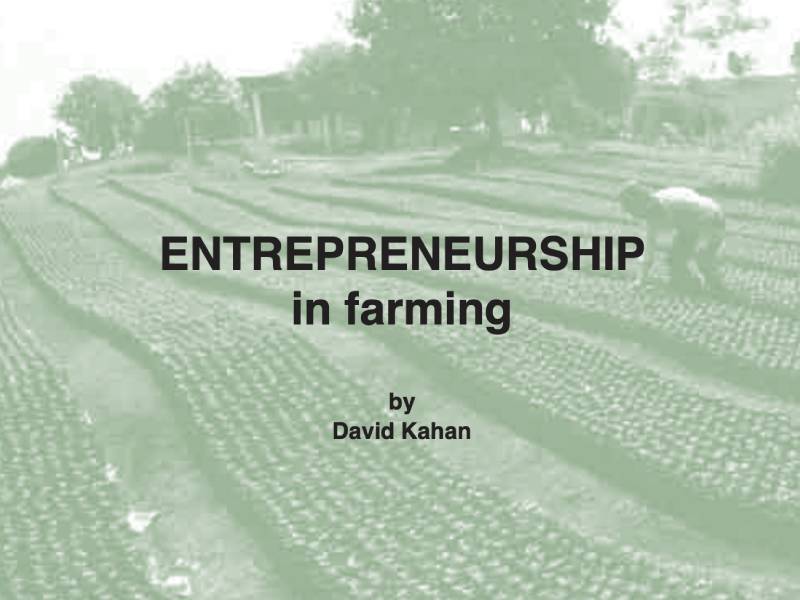
Can small-scale farmers become entrepreneurs? Yes. Small-scale farmers all over the world have shown a remarkable ability to adapt. They look for better ways to organise their farms. They try new crops and cultivars, better animals, and alternative technologies to increase productivity, diversify production, reduce risk – and to increase profits. They have become more marketoriented and have learned to take calculated risks to open or create new markets for their products. Many small-scale farmers have many of the qualities of an entrepreneur.
 Investment into Extension and RAS as part of the Agricultural Innovation SystemsAnnée:2008Téléchargements:9373Date:11 avril 2016Show detailsX
Investment into Extension and RAS as part of the Agricultural Innovation Systems
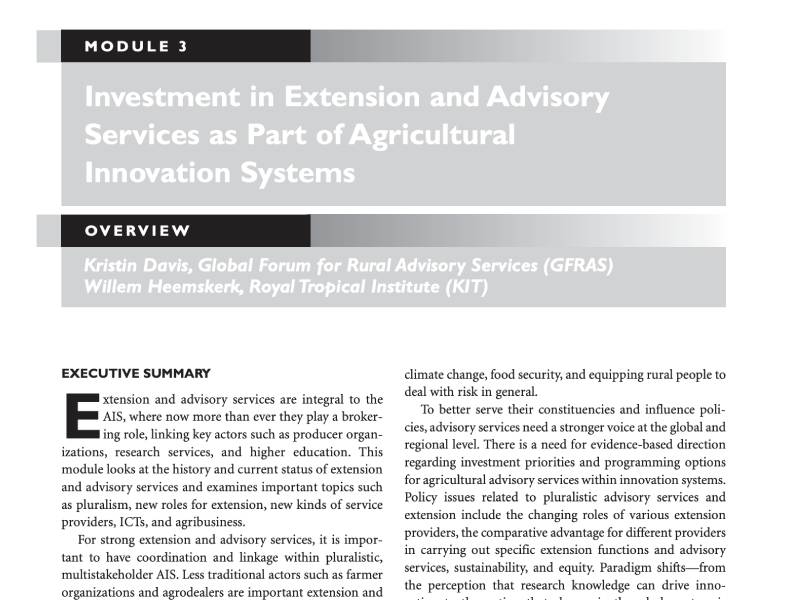
Extension and advisory services are integral to the
AIS, where now more than ever they play a brokering
role, linking key actors such as producer organizations,
research services, and higher education. This module looks at the history and current status of extension and advisory services and examines important topics such as pluralism, new roles for extension, new kinds of service providers, ICTs, and agribusiness. For strong extension and advisory services, it is important to have coordination and linkage within pluralistic, multistakeholder AIS. Less traditional actors such as farmer organizations and agrodealers are important extension and advisory service providers who are vital to include in the design of investments and programs. Extension and advisory services must be ever-adapting to the needs of clients, and they must monitor and evaluate their services.
 Agricultural advisory services and the marketAnnée:2008Téléchargements:4500Date:11 avril 2016Show detailsX
Agricultural advisory services and the market
This paper presents findings of a review of over thirty case studies of field level experience in promoting market orientation in agricultural advisory services. This study was carried out by the Neuchâtel Initiative (www.neuchatelinitiative.net) , an informal network that has been working with advisory service policy reform for the past twelve years. Advisory services are starting to respond more effectively to the needs of farmers and other value chain actors as they adapt to market demands. Despite significant progress in analysing and understanding how to respond to markets, sustainable enhancement of the capacities of the rural poor to benefit from markets will require a more focused and consistent approach. It is particularly important to critically monitor the outcomes of current pilot efforts in providing quality services and in reaching different rural clients.
Concept note 7th GFRAS Annual Meeting 2016Année:2016Téléchargements:50190Date:11 avril 2016Show detailsXConcept note 7th GFRAS Annual Meeting 2016
The Role of Rural Advisory Services for Inclusive Agripreneurship
Rural advisory services (RAS), also called extension services, are fundamental to support rural people to face existing and emerging challenges, and to improve their livelihoods. GFRAS was initiated in 2010 to provide advocacy and leadership on pluralistic and demand-driven rural advisory services for sustainable development. The forum includes networks representing RAS on regional, sub-regional, and national levels, and actors from all sectors and domains involved in RAS. The Annual Meeting is the central instrument for GFRAS to foster learning and exchange and to discuss and strengthen the functioning of GFRAS and its regional networks and national fora.
Peer Exchanges on Extension Innovations Téléchargements:4928Date:8 avril 2016Show detailsX
Peer Exchanges on Extension Innovations
An Action Research Project of the RELASER Network in Latin America
The Modernizing Extension and Advisory Services (MEAS) project, a USAID activity implemented by a University of Illinois at Urbana-Champaign (UIUC)-led consortium, has the objective of defining and disseminating good practice strategies and approaches for establishing efficient, effective and financially sustainable rural extension and advisory service systems. MEAS has focused its efforts in Latin America through partnerships with organiza-tions that have strong involvement with extension system development in the region. The Latin American Network for Rural Extension Services (RELASER) and the Food and Agriculture Organization of the United Nations (FAO) partnered in this initiative to provide six exchanges where innovative programs and practices are shared with extension organizations involving 12 countries in South America over the course of calendar year 2015.
Marco estratégico 2016-2025 Téléchargements:5782Date:8 avril 2016Show detailsX
Marco estratégico 2016-2025
 Este documento1 está dirigido a la comunidad del Foro Global para los Servicios de Asesoría Rural (GFRAS): redes regionales, grupos de trabajo, financiadores, miembros y afiliados. El documento presenta el marco estratégico a través del cual GFRAS cumplirá con su visión y misión durante el período 2016-2025. Explica por qué se creó el Foro y por qué se necesita una nueva estrategia (antecedentes y fundamentos), lo que GFRAS aspira lograr (visión y misión), y cómo se lo llevará a cabo (campos estratégicos de acción). Ag Ed and Training study by SDCTéléchargements:9798Date:23 mars 2016Show detailsX
Ag Ed and Training study by SDC
A study of ATVET in developing countriesConceptualizing Drivers of Policy Change in Agriculture, Nutrition, and Food SecurityShow detailsXConceptualizing Drivers of Policy Change in Agriculture, Nutrition, and Food Security
The Kaleidoscope Model
The current emphasis in the development community on demonstrating policy impact requires a better understanding of national policymaking processes to recognize opportunities for, and limits to, generating policy change. Consequently, this paper introduces an applied framework, named the kaleidoscope model, to analyze drivers of change in the food security arena, with a specific emphasis on agriculture and nutrition policies. Focusing on five key elements of the policy cycle—agenda setting, design, adoption, implementation, and evaluation and reform—the model identifies key variables that define the necessary and sufficient conditions for policy change to occur. These variables were inductively derived through an extensive review of the secondary literature on episodes of policy change in developing countries across a broad range of policy domains related to food security, including agriculture, education, healthcare, nutrition, and social protection.
The advantages of the framework are at least fourfold. First, it incorporates issues of power and conflict much more than existing operational hypotheses in the donor community. Second, compared with many traditional public policy theories, it recognizes the importance of external actors, including donors, and the simultaneous influence of interests, ideas, and institutions. Third, it helps trace why a policy fails to be implemented by taking into account where gaps may have existed during other stages of the policy cycle. Finally, it is readily amenable to operationalization and application to a broader set of country case studies. Collectively, the model aspires to improve the relevance of public policy theories to the developing-country context; offer practical recommendations to key partners; and inform ongoing policy change processes, such as the Feed the Future initiative of the United States Agency for International Development (USAID).
Rural Advisory Services and International CooperationAnnée:2016Téléchargements:6206Date:14 mars 2016Show detailsXRural Advisory Services and International Cooperation
“How can Rural Advisory Services (RAS) reach millions of smallholder farmers in a poverty oriented, ecological, and financially sustainable way?” This was the starting question of a one-year learning process undertaken by the Swiss Agency for Development and Cooperation’s (SDC’s) Agriculture and Food Security Network. The learning process began in September 2014 with a review of project documents and selected key informant interviews pertaining to long-term SDC-financed rural advisory projects in Vietnam, Laos, Bangladesh, Nepal and Kyrgyzstan. Also considered were RAS systems in China and India, where development partners play a lesser role. The book’s reflections on 20 years of experiences in Asia articulates the lessons learned and provides recommendations on how RAS systems can best reach out to large numbers of agricultural women and men producers in a poverty-oriented, ecological and financially sustainable way.
© GFRAS 2026, Global Forum for Rural Advisory Services.