
-
Sur nous
- Mission & Domaines d'action
- Histoire
- Acteurs
- Gouvernance
- Equipe du secrétariat
- Télécharger
- Emploi
- Financeurs
- Activités
- Rencontres Annuelles
- The 'New Extensionist'
- Nutrition et SCR
- Informatiques en SCR
- Global Good Practices
- Politiques pour les SCR
- Organisations de producteur et les SCR
- Egalié des genres dans SCR
- Améliorer les évaluations des SCR
- RAS Blogs
- Savoir
- Publications de GFRAS
- Global Good Practices
- Policy Compendium
- New Extensionist Learning Kit NELK
- Répertoire de fournisseurs SCR
- Répertoire de formation SCR
- Etude mondial de l'extension
- Tous les documents
- Communauté
- Réseaux regionals
- Forums nationaux
- Associés
- Groupes de travail
- Liste des experts
- GFRAS Update
- Message Board
- Community Area New
- Evénements
-
Sur nous
- Mission & Domaines d'action
- Histoire
- Acteurs
- Gouvernance
- Equipe du secrétariat
- Télécharger
- Emploi
- Financeurs
- Activités
- Rencontres Annuelles
- The 'New Extensionist'
- Nutrition et SCR
- Informatiques en SCR
- Global Good Practices
- Politiques pour les SCR
- Organisations de producteur et les SCR
- Egalié des genres dans SCR
- Améliorer les évaluations des SCR
- RAS Blogs
- Savoir
- Publications de GFRAS
- Global Good Practices
- Policy Compendium
- New Extensionist Learning Kit NELK
- Répertoire de fournisseurs SCR
- Répertoire de formation SCR
- Etude mondial de l'extension
- Tous les documents
- Communauté
All Categories
- Accueil /
- All downloads
NELK Module 12 : Le genre dans le cadre des services de vulgarisation et de conseil - Cahier d'activités Année:2017Téléchargements:8508Date:21 juillet 2017Show detailsX
NELK Module 12 : Le genre dans le cadre des services de vulgarisation et de conseil - Cahier d'activités
Une fois que vous aurez lu la vue d’ensemble et l’introduction du module, veuillez effectuer la pré-évaluation suivante afin de déterminer si vous avez ou non des difficultés à aborder le sujet de la vulgarisation. Veuillez évaluer vos connaissances sur le sujet sur une échelle de 1 à 5 en entourant le chiffre correspondant.
NELK Module 12: Le genre dans le cadre des services de vulgarisation et de conseil - ManualAnnée:2017Téléchargements:10504Date:21 juillet 2017Show detailsXNELK Module 12: Le genre dans le cadre des services de vulgarisation et de conseil - Manual
Afin de mener à bien leurs mandats et de contribuer à des changements positifs, les vulgarisateurs ont besoin des connaissances et des compétences requises pour aborder les questions cruciales ayant trait au genre dans les moyens de subsistance ruraux. Les femmes et les hommes, jeunes et âgés, jouent tous des rôles essentiels dans les moyens de subsistance ruraux, mais des suppositions sont souvent faites sur qui fait quoi et qui prend les décisions. Ces aspects détaillés du genre et de la prise de décisions sont cruciaux pour cibler les efforts et aider toutes les personnes concernées par les moyens de subsistance ruraux et l’agriculture à profiter des innovations et des technologies améliorées.
Ce module sur le genre est conçu pour vous aider à comprendre pourquoi ces concepts sont importants dans le cadre de la vulgarisation. Vous apprendrez à identifier pourquoi différents membres de la communauté ont des besoins différents sur le plan de la vulgarisation, et la manière dont vous pouvez commencer à les aborder. Une fois que vous comprendrez ces différents besoins, vous pourrez mieux relier les technologies et les opportunités, mettre en oeuvre des programmes fructueux, et éviter d’empirer la situation de qui que ce soit. Ce module vous aidera aussi à vous améliorer dans votre (ou vos) rôle(s) en matière de vulgarisation afin de mieux satisfaire les besoins cruciaux dans le cadre des moyens de subsistance
ruraux.
RELASER Country Fora - Methodolocical guideline for development and sustainabilityAnnée:2016Téléchargements:5369Date:20 juillet 2017Show detailsXRELASER Country Fora - Methodolocical guideline for development and sustainability
 The Latin American Network for Rural Extension Services (RELASER) was created in October of 2010 as an institutional space for the promotion and strengthening of Rural Extension and Advisory Services (REAS) in Latin America. It promotes dialogue and cooperation to generate approaches, strategies, policies, methodologies and tools for REAS, agricultural innovation and rural development. The network works through the exchange of experiences, information and knowledge.
A key element of the strategy of RELASER and GFRAS is building and strengthening Country Fora (CF) of the network at the country level. The Country Fora of RELASER have the objective of highlighting the topic of extension in the national debate towards its improvement. They work by identifying, classifying and articulating relevant actors to jointly develop a Work Plan to influence the country's policies.
GFRAS – Providing advocacy and leadership in rural advisory services (RAS) for sustainable developmentAnnée:2016Téléchargements:4033Date:20 juillet 2017Show detailsXGFRAS – Providing advocacy and leadership in rural advisory services (RAS) for sustainable development
 The Global Forum for Rural Advisory Services (GFRAS) seeks to strengthen rural advisory services (RAS) by providing a platform for learning and exchange for stakeholders in agricultural innovation systems. GFRAS provides advocacy and evidence on the relevance and contributions of RAS to achieving sustainable development, and particularly to ending poverty and hunger. This is at the heart of the 2030 Agenda for Sustainable Development, reflected specifically in SDGs 1 and 2.Enabling advisory services for climate-smart agricultureAnnée:2017Téléchargements:5176Date:13 juillet 2017Show detailsX
Enabling advisory services for climate-smart agriculture
Policy Brief
Implementing Climate-Smart Agriculture (CSA) practices requires changes in the behavior and strategy of millions of farmers. Rural Advisory Services (RAS) can play a crucial role in transitioning to CSA and help build resilient agrifood systems if a conducive environment for their effective functioning is created.
ICT in Agriculture: Connecting Smallholders to Knowledge, Networks, and InstitutionsAnnée:2017Téléchargements:3172Date:11 juillet 2017Show detailsXICT in Agriculture: Connecting Smallholders to Knowledge, Networks, and Institutions
Information and communication technology (ICT) has always mattered in agriculture. Ever since people have grown crops, raised livestock, and caught fish, they have sought information from one another. Today, ICT represents a tremendous opportunity for rural populations to improve productivity, to enhance food and nutrition security, to access markets, and to find employment opportunities in a revitalized sector. ICT has unleashed incredible potential to improve agriculture, and it has found a foothold even in poor smallholder farms. ICT in Agriculture, Updated Edition is the revised version of the popular ICT in Agriculture e-Sourcebook, first launched in 2011 and designed to support practitioners, decision makers, and development partners who work at the intersection of ICT and agriculture. Our hope is that this updated Sourcebook will be a practical guide to understanding current trends, implementing appropriate interventions, and evaluating the impact of ICT interventions in agricultural programs.
Updated version 2017
A-Card- Financial product for smallholders' digital purchase of farm inputs in BangladeshTéléchargements:4403Date:10 juillet 2017Realities, Perceptions, Challenges and Aspirations of Rural Youth in Dryland Agriculture in the Midelt Province, MoroccoAnnée:2017Téléchargements:2323Date:19 juin 2017Show detailsXRealities, Perceptions, Challenges and Aspirations of Rural Youth in Dryland Agriculture in the Midelt Province, Morocco
Active involvement of youth in agriculture is necessary for sustainable agricultural systems but is currently a challenge in many areas. Using a combination of qualitative and quantitative participatory research methods, this study analyses rural youth’s realities, perspectives and aspirations in dryland Agricultural Livelihood Systems (ALSs) in the Midelt Province, Morocco,
with a particular focus on gender. The data collected are an important first step in understanding the target group and working with youth to identify and develop appropriate programmatic interventions to improve their livelihoods and rural futures. Prior to expressing their aspirations for their rural life and career, the youth first raised the issue of unfulfilled primary needs: access to education, potable water, heath care, and lack of infrastructure in their villages. The issue of outmigration from rural areas is controversial and not so widespread. The youth’s dream village is envisioned as a rural place where people have a more comfortable life with their own families, farming better and more sustainably rather than seeking a job in urban areas. To support the youth’s aspirations and their willingness to stay in agriculture, there is a need for infrastructural and regulatory interventions and specific training in agricultural practices targeting and engaging youth.
Rural tourism as a rural territorial development strategy: a survey for the Colombian caseTéléchargements:2713Date:12 juin 2017Show detailsXRural tourism as a rural territorial development strategy: a survey for the Colombian case
Involving the use of endogenous resources, know-how and territorial identity, Rural Territorial Development (RTD) is a recent approach based on improving local productive systems competitiveness on the basis of regional inherent multifunctionality and pluriactivity. In recent years, rural tourism has become one of the strategies adopted for promotion, development and integration of local agents, leading not only to improved competitiveness but to higher income as well. The current work presents recent trends and advances in the development of rural tourism as an income diversification strategy for local rural populations. It analyzes the impact of this activity in rural areas, together with its participation and importance in the tourism sector. Finally, some experiences in the development of rural tourism in Colombia and its normative and legal frame work are reviewed.
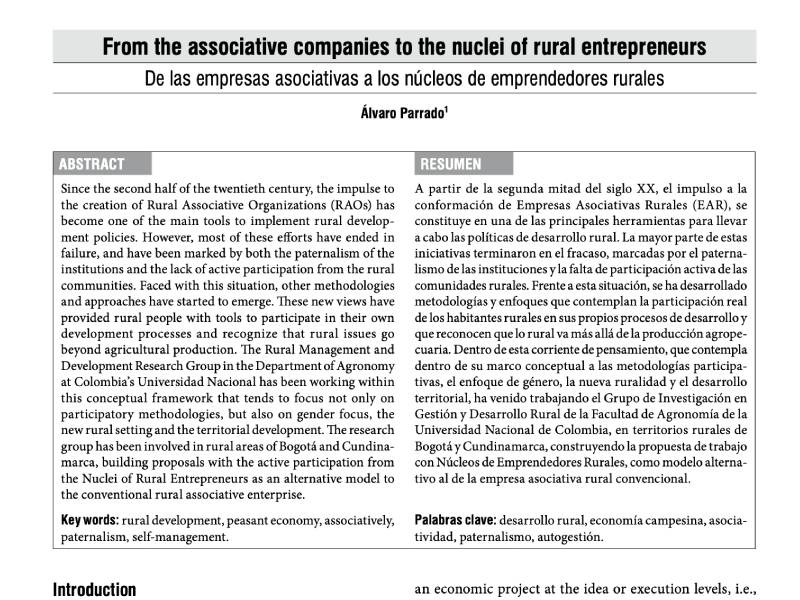 From the associative companies to the nuclei or rural entrepreneurs.Téléchargements:2622Date:9 juin 2017Show detailsX
From the associative companies to the nuclei or rural entrepreneurs.
As a result of the research fieldwork and of permanent academic reflection by the Research Group on Rural Management and Development at Colombia’s Universidad Nacional (GIGDR for its name in Spanish), the methodological approach was constructed to support the “Nuclei of Rural Entrepreneurs”, seeking to respond to the need to strengthen sustainable development processes with the communities and bearing in mind that most institutional initiatives aimed at rural development have limited resources, which are assigned for short-term projects. The GIGDR defines the Nuclei of Rural Entrepreneurs (NRE) as groups of individuals within a territory who develop innovative processes in some aspect pertinent to their context or productive problems. The research group has been involved in rural areas of Colombia, building proposals with the active participation from the NREs as an alternative model to the conventional rural associative enterprise.
Can mobile phone-based animated videos induce learning and technology adoption among low- literate farmers? A field experiment in Burkina FasoAnnée:2017Téléchargements:2579Date:22 mai 2017Show detailsXCan mobile phone-based animated videos induce learning and technology adoption among low- literate farmers? A field experiment in Burkina Faso
This article explores an innovative approach to deliver information about new agricultural technology that combines a versatile and potentially lower cost method of developing animated videos with another low-cost method of sharing it on mobile devices (i.e. mobile phone). It describes a randomized controlled field experiment conducted in Burkina Faso to evaluate the effectiveness of animated videos shown on mobile phone compared with the traditional extension method (live demonstration) in inducing learning and adoption of two postharvest technologies among low-literate farmers. Results suggest that video-based training was as effective as the traditional method in inducing learning and understanding. For technologies that farmers were already aware of animated video shown on the mobile phone was also as effective as live demonstration in inducing adoption. However, in transferring new technologies, the traditional method was more effective in inducing adoption at p < .10, but not at p < .05. Potential role of mobile phone-based videos as part of the agricultural extension system is discussed.
Résumé 7e réunion annuelle du GFRAS7e réunion annuelle du GFRASAnnée:2017Téléchargements:4301Date:18 mai 2017Disruptive technologies - Big data and internet of things in strengthening extension & advisory servicesAnnée:2017Téléchargements:3229Date:18 mai 2017Show detailsXDisruptive technologies - Big data and internet of things in strengthening extension & advisory services
Future Extension and Advisory Services (EAS) needs to strategize convergence of big data with disruptive technologies such as mobile/cloud computing, Internet of Things, location-based social networks etc. Dr Shaik N Meera presents a framework to exploit these developments to strengthen EAS provision in this blog.
GGP Note #17: mExtension – Mobile Phones for Agricultural Advisory ServicesAnnée:2015Téléchargements:3653Date:12 mai 2017Show detailsXGGP Note #17: mExtension – Mobile Phones for Agricultural Advisory Services
 In the last few decades, information and communication technologies (ICTs) have provided immense opportunities for the social and economic development of rural people, and some technologies have surpassed others. Mobile telephony is one such technology that has developed significantly in the past few years, and the subscription rate in developing countries has gone up from 22 per 100 inhabitants in 2005 to 91.8 per 100 inhabitants in 2015. Mobile technology goes beyond geographic, socio-economic, and cultural barriers and this large increase in mobile subscriptions, along with the recent roll out of 3G and 4G technology, can play a big role in the development of rural people.GGP Note #11: Navigating ICTs for Extension and Advisory ServicesAnnée:2015Téléchargements:3273Date:12 mai 2017Show detailsX
GGP Note #11: Navigating ICTs for Extension and Advisory Services
 Improved availability of, and access to, information and communication technologies (ICTs) – especially mobile phones, computers, radio, internet, and social media – has provided many more opportunities for collection, processing, storage, retrieval, managing, and sharing of information in multiple formats. Some of these applications, such as tele-centres, web-portals, call centres, mobile apps, community radio, digital videos, audio and video conferencing, and e-learning platforms, have the potential to provide a wide range of services (information, awareness, promotional, advisory, knowledge, technology transfer, training, education, and much more) to farmers and other agricultural innovation system (AIS) actors in a timely, comprehensive, cost-effective, and interactive manner. However, the high number and rapidly changing availability of ICTs may leave extension managers confused as to which methods are available and when to use them. This note explains how to navigate the many types and gives tips on when to use them.© GFRAS 2026, Global Forum for Rural Advisory Services.