
-
Quienes Somos
- Misión & Campos estratégicos
- Historia
- Actores
- Gobernanza
- Colaboradores
- Descargar
- Oportunidades
- Partners
- Actividados
- Reuniones Anuales
- The 'New Extensionist'
- Políticas para Extensión y SAR
- Global Good Practices
- TIC en Servicios de Asesoría Rural
- Nutricion y SAR
- Organizaciones de Productores de SCA
- Igualdad de Género en SAR
- Iniciativa de Evaluación
- Conocimientos
- Publicaciónes del GFRAS
- Global Good Practices
- RAS Policy Compendium
- New Extensionist Learning Kit NELK
- Directorio Proveedores Extensión
- Estudio Mundial de Extensión
- Todos los documentos
- Community Area New
- Comunidad
- Eventos
-
Quienes Somos
- Misión & Campos estratégicos
- Historia
- Actores
- Gobernanza
- Colaboradores
- Descargar
- Oportunidades
- Partners
- Actividados
- Reuniones Anuales
- The 'New Extensionist'
- Políticas para Extensión y SAR
- Global Good Practices
- TIC en Servicios de Asesoría Rural
- Nutricion y SAR
- Organizaciones de Productores de SCA
- Igualdad de Género en SAR
- Iniciativa de Evaluación
- Conocimientos
- Publicaciónes del GFRAS
- Global Good Practices
- RAS Policy Compendium
- New Extensionist Learning Kit NELK
- Directorio Proveedores Extensión
- Estudio Mundial de Extensión
- Todos los documentos
- Community Area New
- Comunidad
All Categories
- Inicio /
- All downloads
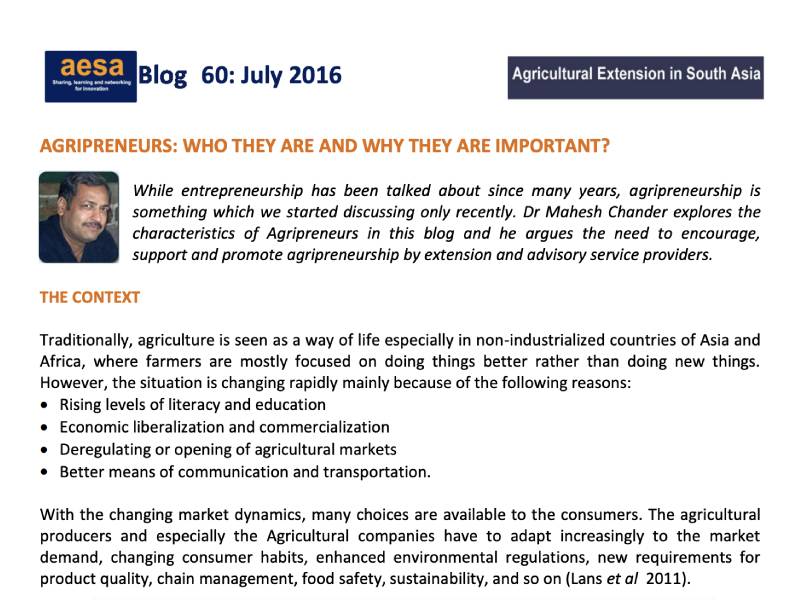 AGRIPRENEURS: WHO THEY ARE AND WHY THEY ARE IMPORTANT?Downloads:5647Date:04 Abril 2017Show detailsX
AGRIPRENEURS: WHO THEY ARE AND WHY THEY ARE IMPORTANT?
While entrepreneurship has been talked about since many years, agripreneurship is something which we started discussing only recently. The characteristics of Agripreneurs have been discussed in this blog and argues the need to encourage, support and promote agripreneurship by extension and advisory service providers has been emphasized.
Rural-Urban Transformations and Food SystemsDownloads:2758Date:04 Abril 2017Show detailsXRural-Urban Transformations and Food Systems
 Re-framing food security narratives and identifying policy options that foster sustainable transitions
A list of publications
Credit, risk & market orientations of the rural farming youth of Uttar Pradesh & Rajasthan.Downloads:2429Date:26 Marzo 2017Show detailsXCredit, risk & market orientations of the rural farming youth of Uttar Pradesh & Rajasthan.
 Credit, risk & market orientations of the rural farming youth of Uttar Pradesh & Rajasthan.were studied.These orientations have bearing on the entrepreneurship and migration among rural youth in India.Comparison of educational & occupational aspirations of rural youth from farming families of Kerala & RajasthanDownloads:3443Date:26 Marzo 2017Show detailsX
Comparison of educational & occupational aspirations of rural youth from farming families of Kerala & Rajasthan
 This is the study conducted on educational and occupational aspirations of rural youth in 4 Indian states viz Kerala, Rajasthan, Uttar Pradesh & West Bengal.Youth: Potential Target for Agricultural ExtensionDownloads:12329Date:25 Marzo 2017Show detailsX
Youth: Potential Target for Agricultural Extension
 Attracting and retaining youth in agriculture is critical for Indian Agriculture. Most of the new innovations (both technical and institutional) require a skilled agricultural work force. For instance, promotion of high value agriculture, precision farming, organic cultivation, Hi-Tech horticulture, micro-propagation, Integrated Pest Disease & Nutrients Management, Post Harvest Management, development of backward and forward linkages etc, require well trained young farmers with enthusiasm and passion for farming and ability to take risks. The rural youth could be the ideal target for skill training in these new areas of agricultural growth and to do this effectively there is a need to mobilize young farmers. Organised groups of young farmers will be useful for introducing new production technologies and organizing effective input and output markets.Agricultural extension services should tap the energy and creativity of rural youth to transform agricultural sector.RUAF FoundationVersion:2017Downloads:0Date:24 Marzo 2017Show detailsX
RUAF Foundation
RUAF is a global partnership on sustainable Urban Agriculture and Food Systems The current members of the RUAF Partnership are a mix of municipalities, research institutes, and NGO’s and include: the International Water Management Institute (IWMI) based in Colombo, Sri Lanka; The Institute of Geographical Sciences and Natural Resources Research of the Chinese Academy of Sciences (IGSNRR/CAS), based in Beijing, China; The Centre for Sustainable Food Systems, Wilfrid Laurier University and the Toronto Food Policy Council from Canada, The Municipality of Ghent, Belgium, CONQUITO, the Municipality of Quito, Ecuador, and the NGO’s Economia e Sostenibilita (ESTA) from Milan, Italy and the Mazingira Institute, based in Nairobi, Kenya. The partnership is managed by the RUAF Foundation.
Guide to the Use of Digital Financial Services in AgricultureVersion:2016Downloads:4184Date:22 Marzo 2017Show detailsXGuide to the Use of Digital Financial Services in Agriculture
 Smallholder farmers (SHFs) have the potential to play an ever increasing role in feeding the world through sustainable supply of key agricultural commodities. However, most smallholders lack their own funds to invest in their farms to improve productivity and connect to markets. Without inclusive market systems, smallholders must rely on their own limited savings to invest in their farm, education, and other household needs, which contributes to lower productivity, persistent income inequality, and slower economic growth.
The goal of this Guide is to identify specific challenges in value chains that can be addressed by improved payments or financial services, and then to identify corresponding DFS solutions to these specific challenges, with the aim of improving the ability of value chains to increase farmer incomes. In doing so, it is possible to increase farmer household access to a transaction account that builds household resiliency and offers access to payments and financial services long after an aid project or intervention is complete.
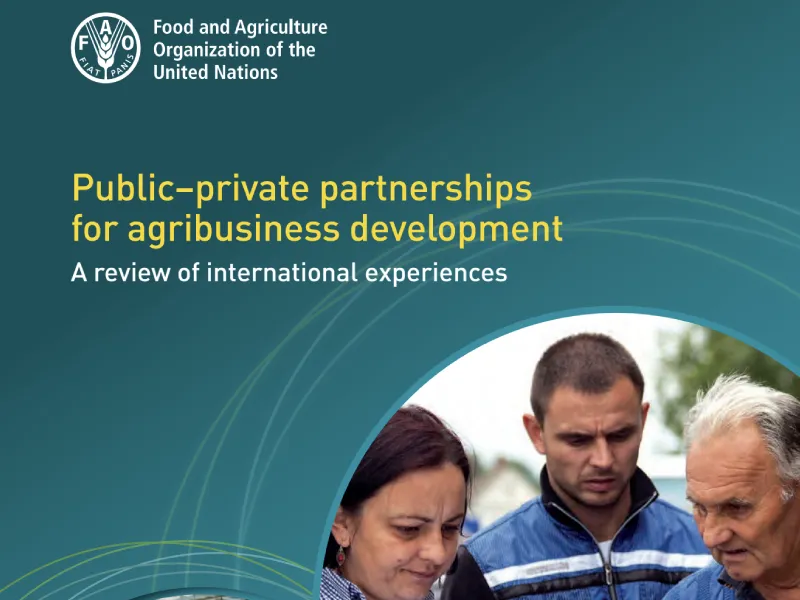 Public–private partnerships for agribusiness developmentVersion:2016Downloads:4605Date:13 Marzo 2017Show detailsX
Public–private partnerships for agribusiness development
Against a background of limited government resources and expertise, innovative partnerships that bring together business, government and civil society actors are increasingly being promoted as a mechanism for improving productivity and driving growth in agriculture and food sectors around the world. Commonly referred to as public–private partnerships (PPPs), these initiatives are common in sectors such as infrastructure, health and education, but their application in the agriculture sector is relatively new. Agri-PPPs are broadly promoted as having the potential to help modernize the agriculture sector and deliver multiple benefits that can contribute towards sustainable agricultural development that is inclusive of smallholder farmers. However, the motivation behind this approach and the loose manner in which the concept is defined raise many unanswered questions about the types of project that may be suitably governed by agri-PPPs.
Information and Communication Technologies for Agricultural and Rural DevelopmentVersion:2017Downloads:4570Date:07 Marzo 2017Show detailsXInformation and Communication Technologies for Agricultural and Rural Development
Success Stories
 This publication showcases a few case studies where innovative use of emerging technologies together with capacity development has brought about rich dividends. Digital Green’s experiences in knowledge sharing among rural communities to Nano Ganesh’s innovative use of technology in switching on irrigation pumps have the potential to contribute significantly to the livelihoods of farming communities. NELK Module 13 Risk Mitigation and Adaptation in Extension and Advisory Services - ManualDownloads:21358Date:24 Febrero 2017Show detailsX
NELK Module 13 Risk Mitigation and Adaptation in Extension and Advisory Services - Manual
This module aims to familiarise you with risk management and adaptation planning in EAS. You will be introduced to the concepts of risk and uncertainty in order to better understand the impact of factors such as market and climate variability in the agricultural sector. You will also be provided with skills, tools and knowledge to address these factors through the use of risk management and adaptation strategies. Remember that this module not only focuses on improving your own risk management capacity but also focuses on your ability to improve the capacity of rural farmers; a primary goal of EAS.
NELK Module 13 Risk Mitigation and Adaptation in Extension and Advisory Services - WorkbookVersion:2016Downloads:9333Date:24 Febrero 2017NELK Module 13 Risk Mitigation and Adaptation in Extension and Advisory Services - Lecturer GuideVersion:2016Downloads:9343Date:24 Febrero 2017NELK Module 13 Risk Mitigation and Adaptation in Extension and Advisory Services - PresentationVersion:2016Downloads:9664Date:24 Febrero 2017NELK Module 12 Gender in Extension and Advisory Services - ManualVersion:2016Downloads:16851Date:24 Febrero 2017Show detailsXNELK Module 12 Gender in Extension and Advisory Services - Manual
In order to deliver on their mandates and contribute to positive change, extensionists need a well developed understanding of, and the skills necessary to address critical issues around gender in rural livelihoods. Men and women, young and old, all play vital roles in rural livelihoods, but assumptions are often made about who does what and who makes the decisions. These details of gender and decision making are critical to targeting efforts and helping everyone involved in rural livelihoods and agriculture benefit from innovations and improved technologies.
This module on gender is designed to help you understand why these concepts are important in extension. You will learn how to identify why different community members have different needs from extension, and how you can begin addressing them. By understanding these different needs, you will be able to better match the best technologies to opportunities, deliver successful programmes, and avoid making anyone’s situation worse. This module will also help you improve in your role(s) in extension to better meet critical needs in rural livelihoods.
NELK Module 12 Gender in Extension and Advisory Services - WorkbookVersion:2016Downloads:9271Date:24 Febrero 2017© GFRAS 2026, Global Forum for Rural Advisory Services.